

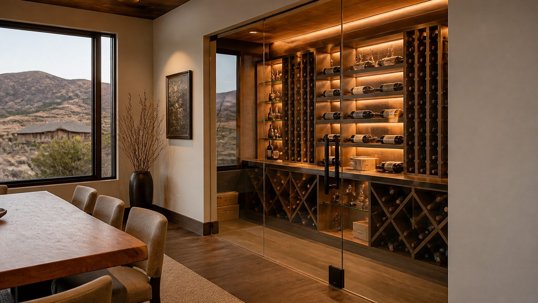
Planning a glass wine room in Boise comes down to a simple question. Can you keep the bottles cool, steady, and slightly humid in a high desert home that swings from hot, dry July afternoons to freezing nights in January? You can, as long as the glass, the door, the cooling, and the location are planned together from the start. When they are, a glass wine room becomes the part of the house your guests notice first and the place your collection is safest.
I'm James Patterson, General Manager at Gatsby Glass of Treasure Valley. I moved to Boise in 2006 and have called it home ever since, and before Gatsby Glass I ran a local business here for ten years. I've seen plenty of Treasure Valley homes, from older houses on the Bench to new builds in Kuna and Star. With holiday entertaining season starting, a lot of homeowners are thinking about where the wine lives when family fills the house. This guide walks through what makes our dry climate different, how to choose the glass and door, what the cooling has to do, and where a wine room fits best in a Boise, Meridian, or Eagle home.
Why a Glass Wine Room in Boise Needs a Different Plan
Most wine room advice is written for humid places, where the main worry is fogged glass and too much moisture. The Treasure Valley has the opposite problem most of the year. According to the NOAA State Climate Summary for Idaho, summer highs in southern Idaho's valleys average close to 90°F, winter lows are typically below freezing, and the lowlands in the southern part of the state can see less than 10 inches of precipitation a year. The same summary describes Idaho summers as already dry.
That combination matters for wine. Dry air pulls moisture out of natural corks over time, and a cork that dries and shrinks can let air into the bottle. Big seasonal swings also make it harder to hold a room at one steady temperature, and steadiness is what long term storage depends on. Our glass wine rooms page gives general guidance of 45°F to 65°F for storage, with about 55°F as the target, and humidity in roughly the 60% to 68% range. In a Boise house that runs dry from forced air heat all winter, reaching that humidity takes planning.
So a wine room here isn't just a nice glass box. It's a small, sealed room that has to hold cool, add moisture, and resist the temperature swings happening on the other side of the glass. The rest of this guide is about getting those pieces to work together.
Four Decisions That Shape Every Wine Room
Every project we talk through starts with the same four decisions. Settling them early keeps the design on track and avoids surprises once the glass is ordered.
- How much you store and how long you keep it. A few cases you'll open over the next year need a very different room than a collection you plan to age for a decade.
- Display or storage first. Some homeowners mainly want the bottles to look great from the dining room. Others care most about conditions inside. Most want both, but knowing your priority helps with every trade-off.
- Where it goes. The location decides how hard the cooling has to work, how much sun hits the glass, and whether there's a realistic path for power and venting.
- How much glass you want. One glass front, two glass walls, or glass on three sides changes the look, the cost, and the cooling load.
Once those are clear, the glass enclosure and the climate control can be designed as one project instead of two separate ones that have to be forced together later.
Corner Nooks, Converted Closets, and Full Rooms
Our wine room page describes projects ranging from a cozy corner or nook all the way to a dedicated wine room. Here's how those options tend to play out in Treasure Valley homes.
The Corner or Nook
A glass front across a corner of the dining room or the end of a kitchen is the simplest version. You see the racking through the glass but don't walk inside. It works well in smaller homes and condos near downtown Boise, and it's a good fit if most of your bottles get opened within a few months.
If you want to keep bottles longer, a nook can still be sealed and cooled. It just needs tighter seals and more thought about the glass than a display only version.
The Converted Closet or Under Stair Space
Plenty of two story homes in Meridian, Eagle, and Star have a coat closet or a space beneath the stairs that never gets used well. Enclosing one of those spaces in glass turns it into a compact wine room without taking over a whole room. These spaces are often easier to cool because they're small and usually sit away from exterior walls.
The Dedicated Room
A walk in wine room gives you the most storage and the biggest presence. It might sit off the dining room, in a finished lower level, or in a space you're adding during a remodel. The trade-off is that a larger room needs a properly insulated shell, a cooling system sized for the volume, and more glass, so there's more to plan.
Choosing Glass for Big Temperature Swings
Glass is what makes a wine room beautiful, and it's also the weakest point for holding temperature. A framed and insulated wall slows heat much better than a single sheet of glass. That's why the glass choice and the cooling plan always have to be discussed together.
Safety Glass Comes First
Our wine room page notes that we use tempered or laminated glass for safety and durability. Tempered glass is heat treated so that if it breaks, it crumbles into small pieces rather than large sharp shards. Laminated glass has a layer bonded between two sheets that holds the pieces together if it cracks. Both are common in wine rooms, and the right one depends on the design.
How Insulated Glass Helps
Insulated glass is one way to cut heat transfer through a glass wall. According to the U.S. Department of Energy, insulated glazing seals two or more panes apart with a gap, often filled with argon gas, and low emissivity coatings reduce heat transfer through the glass. The same guidance explains that warm edge spacers help reduce condensation at the edges of the glass. Those principles come from windows, but they apply to any glass wall separating a cool room from a warm one.
There's a design trade-off. Insulated units are thicker and need sealed edges, so they usually sit in a frame or channel. A single thick panel gives a cleaner frameless look but lets more heat through. Glass options vary by project, so we'll talk through which ones make sense for your room and your look during the design consultation.
Think About What the Glass Faces
Glass facing a dim hallway behaves very differently from glass facing a sunny great room with big west windows. In the Treasure Valley, late afternoon summer sun is strong. If the wine room glass will catch that light through a nearby window, the cooling has to work harder, and the wine is exposed to more light. Keeping the glass out of direct sun is one of the easiest ways to make the room perform better.
The Door Is the Part You Use Most
During a holiday dinner, the wine room door might open dozens of times. It needs to seal tightly, swing without fuss, and look like it belongs with the glass walls.
Doors are also where glass safety rules matter most. The federal safety standard for architectural glazing materials (16 CFR Part 1201) covers glazing used in doors, along with products such as shower doors and sliding glass doors, because people can be seriously hurt walking into or falling against glass that breaks. A wine room door should use safety glazing, and it's reasonable to ask your installer exactly what glass is going in.
A few other door details to talk through.
- A tight seal on all four sides. Gaps at the bottom or edges let cold air spill out and dry house air pour in, which undoes the work of the cooling and humidity system.
- Which way it swings. A door that swings into a busy dining area can get in the way when the table is full. Think through traffic before choosing.
- Hardware that matches the house. Pulls and hinges in a finish that ties into your kitchen or bar hardware make the room feel built in rather than added on.
- A self closing option. In a house full of guests, a door that closes on its own keeps the room from sitting open while everyone talks.
Cooling and Humidity in a High Desert Home
Our wine room page explains that we provide guidance on integrating climate control systems, because temperature and humidity control are essential for storing wine well. The cooling equipment itself is its own trade, so it's planned alongside the glass from the first conversation rather than squeezed in afterward.
Why Your Furnace and AC Aren't Enough
A home HVAC system is designed to keep people comfortable, usually somewhere in the upper 60s to mid 70s. A wine room needs to sit around 55°F year round with steady humidity. In summer, the room is fighting heat coming through the glass. In winter, the rest of the house is heated and very dry, and that dry air pushes in every time the door opens. A dedicated system sized for the room and its glass is the usual answer for anyone planning to age wine.
Adding Moisture, Not Just Removing It
This is where Boise really differs from humid parts of the country. In our climate, the goal is usually to keep enough moisture in the room, not to pull it out. Corks stay healthier when the air around them isn't bone dry. When you're comparing climate control options, ask specifically how each one manages humidity during our dry winters, since some cooling units dry the air as they run.
Power, Venting, and Noise
Cooling units need power, a place to send heat, and sometimes a drain line. Some vent through a wall, some are ducted to another part of the house so the noisy parts are out of earshot, and some are split systems with a unit inside the room and another elsewhere. Each choice affects where solid walls need to be and where glass can go, which is exactly why the two are planned together.
Lighting That Keeps the Room Cool
Good lighting turns a storage room into a showpiece, but some fixtures add heat the cooling system then has to remove. According to the U.S. Department of Energy's guidance on LED lighting, LEDs give off very little heat, while incandescent bulbs release about 90% of their energy as heat. In a small, closed, cooled room, that difference is easy to feel.
Our wine room page also recommends keeping lighting dim to protect wine from UV damage. A few ideas that work well behind glass.
- Low output LED strips along the front edge of racking so labels are easy to read.
- Soft backlighting behind a feature wall of bottles that glows through the glass from the dining room.
- Lighting on its own switch, so it's bright when you're showing off the room and off the rest of the time.
- Warm color temperatures that look good against wood racking and dark bottles.
If you like the idea of hiding the collection some of the time, smart glass can switch from clear to opaque at the touch of a button. Our smart glass page also lists UV protection among its benefits, which pairs well with keeping wine out of strong light.
Where a Wine Room Fits in Treasure Valley Homes
Homes across the valley vary a lot. Older houses on the Bench and in the North End often have smaller rooms and odd corners. Newer neighborhoods in Meridian, Kuna, and Star tend toward open floor plans, great rooms, and two story layouts with stairs near the main living area. Each style has spots that suit a wine room better than others.
Off the Dining Room or Kitchen
This is the favorite for people who host. A glass wine room beside the dining area keeps the collection in view right where guests gather, and it saves trips across the house when you're pouring for a full table.
In an Open Floor Plan
In a great room layout, a glass wine room can also act as a divider between the kitchen and living area. It defines the space without blocking the view. If you like that idea, our glass walls and partitions page shows how glass can separate spaces while keeping a home open and bright.
Lower Levels
Where a home has a finished lower level, it's often the easiest place to keep a room cool, since it's insulated by the ground and stays more stable than upper floors. That can mean a smaller cooling unit and fewer swings through the seasons.
Spots to Avoid
- Exterior walls that bake in late afternoon summer sun.
- Rooms over an unconditioned garage, which can run hot in July and cold in January.
- Spaces beside ovens, fireplaces, or laundry rooms.
- Any location with no realistic route for the cooling unit to vent.
Finishing Touches Around the Wine Room
A wine room rarely stands alone. It's usually part of a dining area, a home bar, or an entertaining space, and the details around it make a big difference in how finished it feels.
Mirrors are one of the easiest ways to tie the area together. An antique mirror wall behind a nearby bar or on the wall facing the wine room bounces the soft lighting around and adds warmth. If you like that look, our post on antique mirrors in Boise homes covers where aged mirror glass works best.
Easy care glass is another detail worth asking about. Boise's hard water and everyday fingerprints show up on clear glass. Our wine room page mentions the Ultra Ice Pro system, which is designed to help glass stay clear and simple to maintain.
Timing Around the Holidays
The holidays are when a wine room gets the most use. It's where the good bottles come out at Thanksgiving, where everyone gathers during a December open house, and where you pull something special for New Year's Eve.
It helps to be realistic about timing. A custom glass wine room depends on framing, insulation, power, and cooling being finished first, and every glass panel is cut to fit the final opening. If you're starting from scratch this month, the room may not be ready before your holiday guests arrive. That's fine. Hosting season is actually a great time to plan, because you can see where people gather and how often you're heading for a bottle.
- Watch where guests naturally collect during your gatherings.
- Count the bottles you keep now and how many you'd like to store.
- Save photos of wine rooms you like, including glass styles, doors, and lighting.
- Schedule a design consultation so the glass and the climate control are planned together from the start.
What to Look for in a Glass Company for Your Wine Room
Every wine room is custom, so the glass partner you choose matters. Whoever you hire, look for these things.
- A way to see the design first. You should be able to preview the room before anything is fabricated. Gatsby Glass of Treasure Valley offers visualization tools so you can see how the glass will look in your space before fabrication begins.
- Clear scope. A good glass company tells you plainly what it handles and what your builder, electrician, or cooling contractor handles.
- Careful measuring. Custom glass is cut to the exact opening, so precise measurements after framing are essential.
- Safety glass and solid hardware. Ask what glass is being used in the walls and door and how the door will seal.
- Local experience. A team that knows Treasure Valley homes and our dry climate will ask the right questions about sun, seasons, and humidity.
Frequently Asked Questions About Glass Wine Rooms in Boise
What temperature and humidity should a wine room in Boise hold?
General guidance is 45°F to 65°F, with about 55°F as a common target for long term storage, and humidity in roughly the 60% to 68% range. In Boise's dry climate, holding enough humidity is often the bigger challenge, so ask how any climate control system handles it.
Does a glass wine room need its own cooling system?
If you plan to age wine, yes. A home furnace and air conditioner are built for people, not for holding a small room near 55°F all year. A dedicated system sized for the room and its glass is the usual approach. A display only nook for bottles you'll open soon can sometimes stay at room temperature.
Will the glass fog up?
Fogging happens when warmer, moist air meets glass colder than its dew point. Because Treasure Valley air is dry most of the year, it's less common here than in humid states. Good glass, a well sealed door, and steady conditions inside the room all help keep the glass clear.
How small can a glass wine room be?
It can be as small as a glass front across a corner or nook, or a compact room in a closet or under the stairs. It can also be a full dedicated room. The right size depends on your collection and how much space you can give it.
What kind of glass is used in a wine room?
Tempered or laminated safety glass is standard for wine rooms, and it's especially important in the door. Depending on the design, insulated glass may be worth considering to reduce heat transfer. We'll talk through the options for your room during the design consultation.
Schedule a Design Consultation in the Treasure Valley
Whether you're picturing a glass nook off the dining room in Boise or a full wine room in a new build in Meridian, Eagle, Kuna, or Star, we'd be glad to help you plan it. Gatsby Glass of Treasure Valley serves homeowners across Boise, Meridian, Nampa, Eagle, Garden City, Kuna, Star, and Emmett. Schedule a design consultation with Gatsby Glass of Treasure Valley and we'll help you plan a wine room that fits your space, your collection, and our high desert climate.